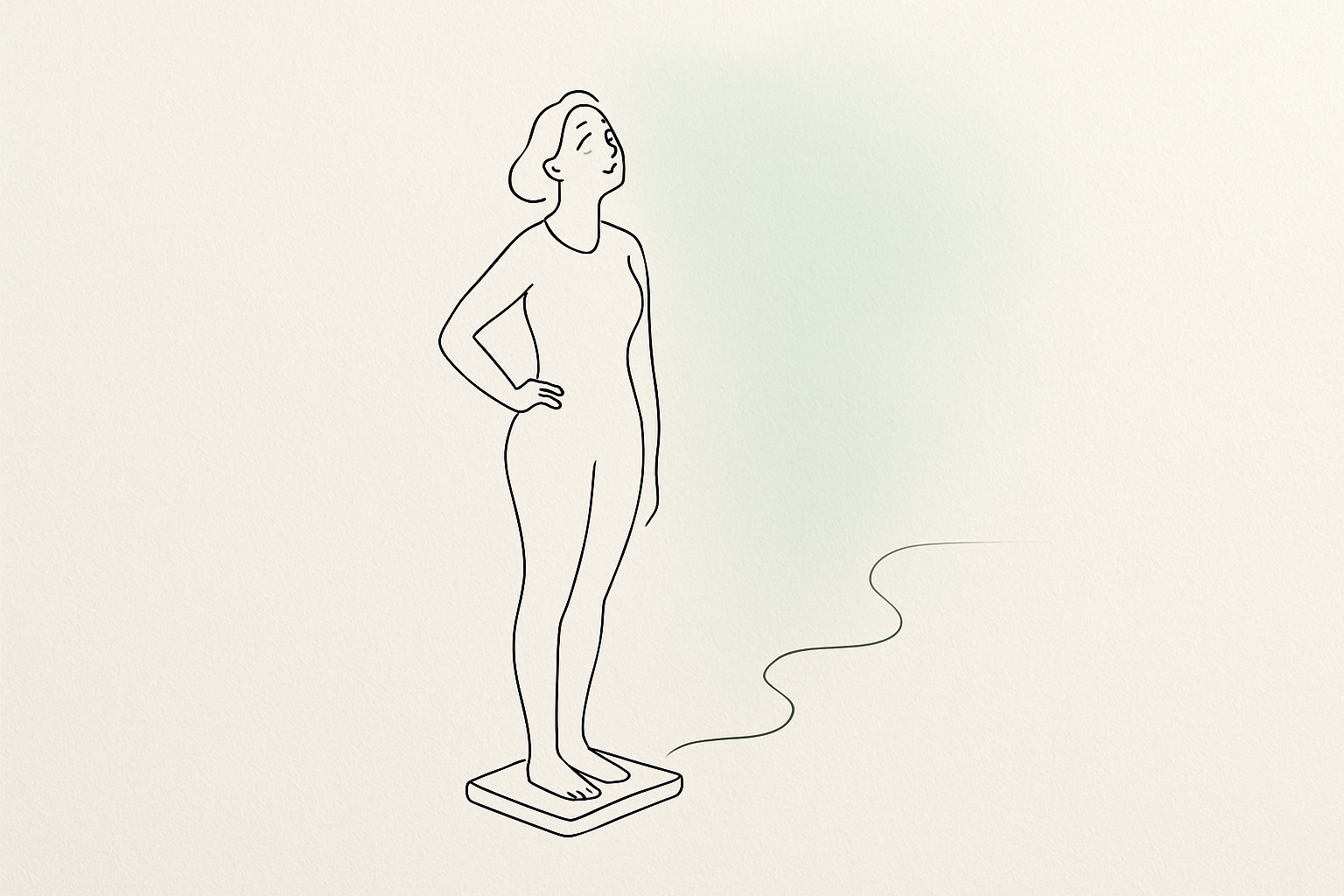
Menopause weight gain has a way of feeling less like “a change” and more like a betrayal.
The scale becomes that moody acquaintance that used to be predictable and now shows up with new opinions and zero context.
And because weight is loaded with cultural baggage, the body’s natural transitions can get interpreted as a personal failure. That story is heavy. The number is not the whole story.
Why menopause weight gain can feel so sudden
During perimenopause and menopause, hormone patterns shift. Estrogen, in particular, becomes less steady over time.
Major health organizations note a pattern: many people notice changes in where weight sits, how hunger shows up, and how the body responds to routines that used to “work.”
It can feel sudden because the body is juggling multiple changes at once: sleep disruption, stress sensitivity, and shifts in muscle mass that happen with age if strength work is not part of the routine.
The belly shift: when the body changes its filing system
A common pattern is a change in fat distribution. The body may start storing more around the abdomen.
This is often the moment the scale feels like a stranger, but the mirror feels like an even bigger plot twist.
Mayo Clinic and Johns Hopkins describe midlife as a time when body composition commonly shifts, including increased abdominal fat.
What usually helps is separating “shape change” from “self-worth.” That sounds simple. It is not. But it is possible.
Metabolism and muscle: the quiet math happening in the background
Metabolism is not a moral scorecard. It is biology, behavior, and context doing group work.
With age, muscle mass can decline if it is not challenged. Muscle is metabolically active tissue, so less muscle can mean the body uses fewer calories at rest.
Then menopause arrives with its own changes, and the math can start to feel unfair.
National Institute on Aging and CDC discuss how physical activity, including muscle-strengthening activity, supports healthy aging and body composition.
What usually helps is reframing the goal from “smaller” to “stronger and steadier.” Not as a slogan. As a practical direction.
Appetite, cravings, and the stress connection
Many people notice cravings that feel louder, especially for quick energy foods.
This is not a character flaw. It can be a signal.
Sleep disruption, stress, and a busy life can amplify hunger cues and reduce the bandwidth for planning meals. The body often asks for faster fuel when it is running on low reserves.
Sleep Foundation notes patterns between sleep and appetite regulation. When sleep is choppy, the body’s signals can get harder to read.
What usually helps is not “more willpower.” It is more structure that feels kind, not punishing.
The movement trap: doing more, recovering less
When the scale changes, many people respond by doing more cardio, more often, with less recovery.
That approach can backfire if it increases stress, disrupts sleep, or crowds out strength work and nourishment.
The body is not a machine that can be bullied into compliance. It is more like a relationship. Pressure changes the tone.
A steadier pattern often includes a mix: walking or other moderate movement, strength training a few times per week, and recovery days that are actually recovery.
ACOG and the American Heart Association highlight the value of regular physical activity for overall health, including a combination of movement types.
Food choices without food drama
Menopause weight gain conversations can turn food into a courtroom. Every bite becomes “evidence.” That is exhausting.
What usually helps is returning to basics and watching patterns for a few weeks.
Some people feel better with more protein at breakfast, steadier fiber through the day, and fewer ultra-processed snack spirals that start at 4 p.m. and end in a pantry blackout.
Not because those foods are “bad,” but because the body may be asking for steadier blood sugar and more satisfying meals.
NIH and MedlinePlus offer general nutrition guidance that supports balanced eating patterns.
-
Try the “add, then adjust” method: add protein, add fiber, add water, add a planned afternoon snack. Then observe what changes before cutting everything fun.
-
Build a repeatable plate: a protein, a fiber-rich carb, a colorful plant, and a satisfying fat. Not perfect. Repeatable.
-
Watch liquid calories gently: alcohol and sweet drinks can add up quickly and can also disrupt sleep for some people.
Sleep: the underestimated weight companion
Sleep and weight are close friends. Sometimes too close.
Night sweats, insomnia, and early waking are common in this transition, and that can make appetite louder and movement harder.
NAMS and Cleveland Clinic describe sleep disruption as a common part of the menopause transition.
What usually helps is a boring, consistent wind-down routine. The kind that feels unglamorous and oddly powerful.
-
Keep the bedroom cool and dark.
-
Anchor wake time most days, even after a rough night.
-
Reduce late caffeine and late heavy meals if they seem to stir things up.
Tracking without spiraling: turning data into self-awareness
Some people do better when they stop weighing themselves. Others do better with a weekly check-in.
The goal is not obedience to the scale. The goal is information without shame.
Consider tracking a few neutral signals for two weeks: sleep quality, strength sessions, daily steps, protein at breakfast, and mood. Then look for patterns.
Often, the body is not “broken.” It is communicating in a new language.
When to seek more support
If weight changes feel rapid, or energy feels unusually low, or the body feels unfamiliar in a concerning way, it can help to talk with a qualified health professional for individualized guidance.
Not because the goal is to chase a smaller body at all costs, but because the goal is to understand what is driving the changes and what supports overall well-being.
Office on Women’s Health offers menopause education that can help with next-step conversations.
A closing reminder for the days the jeans feel judgmental
Menopause weight gain is not a referendum on discipline. It is often a multi-factor shift happening in a busy life, in a changing body, in a culture that acts like bodies are supposed to stay 32 forever.
Progress here is usually quiet. A little more strength. A little more sleep. A little more protein. A little less chaos.
No one can promise an instant fix. But patterns can be named. Routines can be built. And the relationship with the body can become less of a battle and more of a conversation.